New GE regulatory overview report released
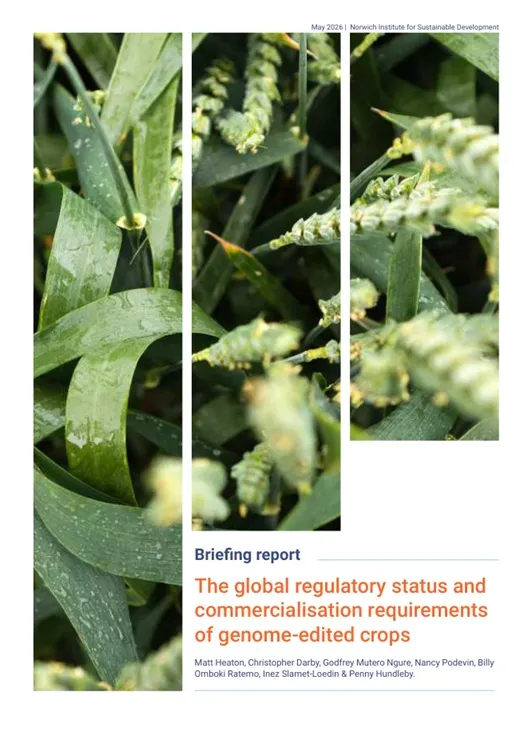
A new report has been released providing an overview of Gene Editing (GE) regulations globally for crops. The report covers:
- How GE regulation has evolved
- The global overview of GE regulatory change
- The emerging future of gene editing crops
- The authors' recommendations for the future, based on this review.
The resources can be freely access, and high resolution links to the figures are provided in the post below.
Overview
Gene Editing (GEd) offers a valuable tool for crop improvement to address nutritional insecurity, climate adaptation and wider societal benefits. However, its impact depends on the nature of policy and regulatory environments that govern the development and use of GEd products.
This report examines how different jurisdictions permit, manage and regulate the use of GEd crop technologies. It outlines GEd regulation across countries and the wider ramifications around regulatory triggers targeting the process and product of GEd development. This includes the potential costs of regulatory misalignment and its impacts for research diversity and trade.
The report argue that crops developed which do not contain transgenes should be regulated as conventionally-bred products, based on their biological equivalence and the disproportionate burden and scientific impracticability in tracking and enforcing control of these products. We close with recommendations for harmonised, product-based regulation, stronger international coordination, improved regulatory performance and communications strategies.
The team is made up of representatives from the Norwich Institute for Sustainable Development, John Innes Centre, International Service for the Acquisition of Agri-biotech Applications, AfriCentre, Corteva Agriscience, African Union Development Agency - New Partnerships for Africa’s Development and the International Rice Research Institute.
Policy map highlights
Global regulations of GE crops are changing. The report explores how regulatory milestones that have taken place globally in how GE crop technologies are recognised.
South America
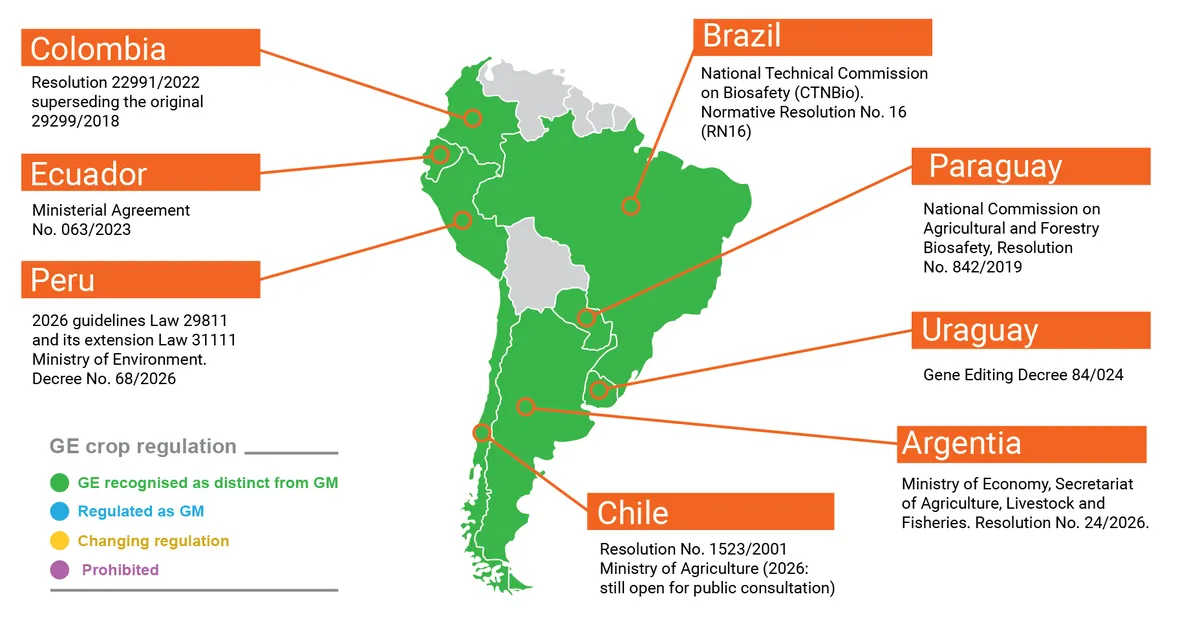
South America has been the most proactive region globally. Argentina enacted the first dedicated GE regulatory criteria in 2015 (Resolution 173/2015), distinguishing transgene-free products from GMOs, and updated this framework in 2026 (Resolution 24/2026).
Chile followed in 2017 with a case-by-case consultation process exempting products without foreign gene insertions, with SAG formalising this in early 2026. Brazil's CTNBio issued Normative Resolution 16 in 2018, clarifying that many GEd products fall outside GM definitions.
Colombia issued a confirmation procedure in 2018, updated in 2022. Paraguay exempted transgene-free products in 2019. Ecuador did the same via Ministerial Agreement 063/2023. Uruguay remains more cautious, establishing a technical working group process via a 2024 Gene Editing Decree.
Peru's MINAM approved guidelines in March 2026 treating transgene-free products as conventionally bred under Laws 29811 and 31111. In 2017, the agriculture ministries of Argentina, Brazil, Chile, Paraguay and Uruguay signed a joint declaration aiming at regional harmonisation.
Central America
Progress has been uneven. El Salvador, Guatemala and Honduras began developing a shared biosafety technical regulation in 2019 (RT 65:06.01:18), exempting transgene-free GEd products from GM requirements. Honduras and Guatemala harmonised the regulation in 2019; El Salvador adopted it in late 2022. Guatemala additionally published Acuerdo Ministerial No. 271 in 2019, simplifying seed evaluation and registration. Honduras' SENASA approved a 45-day simplified GMO-status determination procedure in 2019. Costa Rica updated its biotechnology regulatory framework in 2023 (Executive Decree 44020-MAG), reducing barriers and establishing procedures for determining whether GEd crops qualify as living modified organisms under Phytosanitary Protection Law No. 7664. Panama and the Dominican Republic have not enacted specific frameworks.
North America
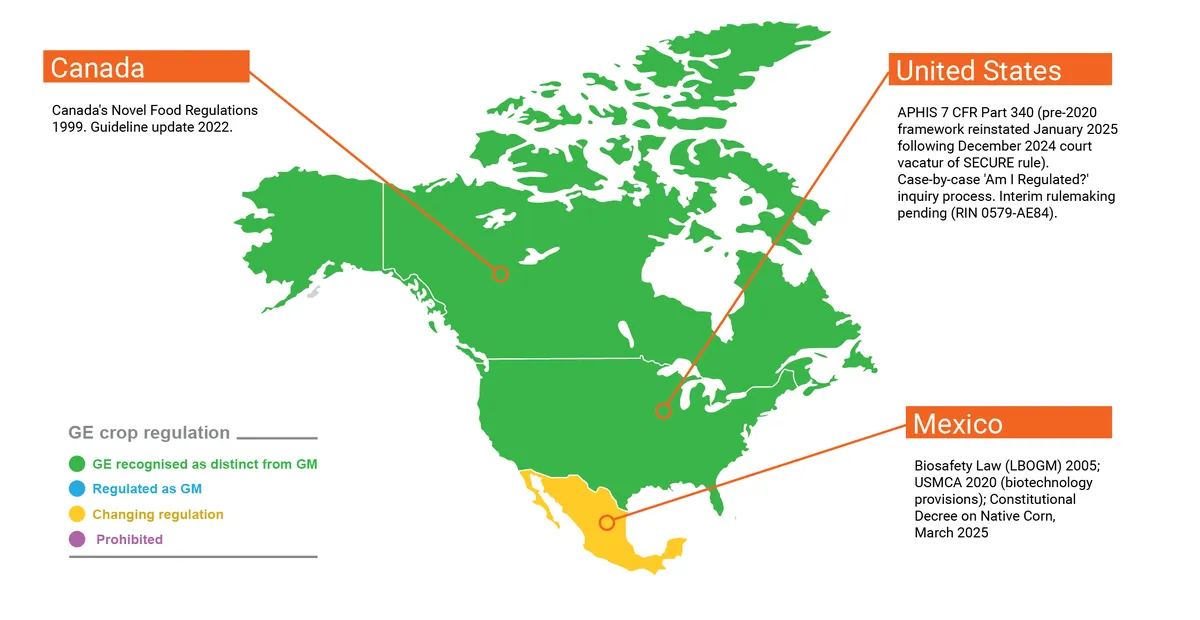
Canada and the United States have broadly adopted enabling frameworks, though with important recent turbulence in the US.
Canada's regulatory trigger has historically focused on trait novelty rather than production process, meaning precision-bred GEd products are not automatically classified as novel under its 1999 Novel Food Regulations (updated 2022).
The US USDA introduced the SECURE Rule in 2020, updating 7 CFR Part 340 to focus on product-based plant-pest risk and exempting GEd plants where the change could have arisen through conventional breeding. However, SECURE was prospectively vacated in December 2024 following a successful legal challenge by anti-GMO groups including the Center for Food Safety, reverting the US to the pre-2020 framework. APHIS restarted the "Am I Regulated?" inquiry process in 2025, with interim rulemaking pending (RIN 0579-AE84). Notably, transgene-free GEd products now sit in an informal regulatory gap and are likely unregulated under the reinstated framework.
Mexico remains restrictive, treating all GEd products as GM under its 2005 Biosafety Law (LBOGM), compounded by a Constitutional Decree on Native Corn in March 2025.
Europe
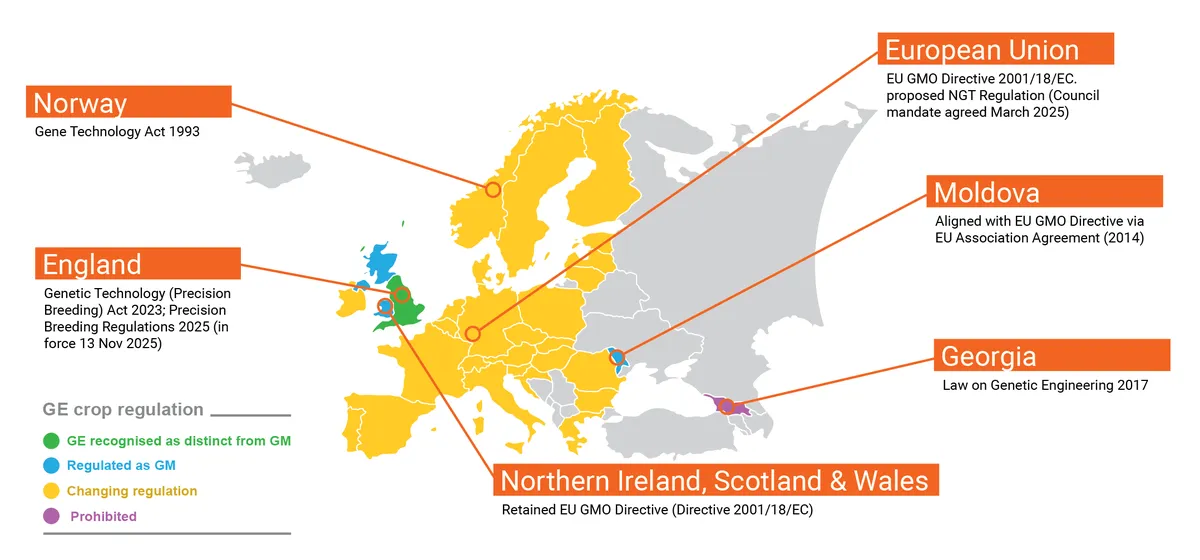
The EU landscape is in transition. The 2018 CJEU ruling (C-528/16) was the definitive catalyst, confirming that virtually all GEd products fell under existing GMO Directive 2001/18/EC, with only techniques with a pre-2001 safety record exempted. In response, the European Commission introduced the 2023 New Genomic Techniques (NGT) proposal, creating a two-tier system: NGT-1 (conventional-like, requiring verification against set criteria plus transparency measures) and NGT-2 (more complex modifications, requiring adapted GMO requirements). The report anticipates the NGT regulation will be adopted and published in summer 2026, followed by a two-year implementation phase.
England diverged post-Brexit through the Genetic Technology (Precision Breeding) Act 2023, creating a new Precision Bred Organisms (PBO) category for changes achievable naturally. The Precision Breeding Regulations 2025 came into force in November 2025, fully operationalising the framework for plants. Critically, Northern Ireland, Scotland and Wales retain EU GMO alignment, though England-grown PBOs must be sold as conventional crops across those borders under the UK Internal Market Act 2020, although downstream processing in Scotland or Wales remains subject to GMO rules.
Norway updated its Gene Technology Act and is maintaining case-by-case assessment, but must align with any EU redefinition of GMOs given its EEA membership. Georgia maintains a blanket ban on GEd plants for cultivation, import and export, making it one of only two such countries globally.
Middle East
The region has been slow to develop GE-specific legislation. Israel's National Committee for Transgenic Plants announced in 2017 and clarified in 2019 that transgene-free plants are exempt from GE regulation on a case-by-case basis. Saudi Arabia permits importation of biotech plant products but requires labelling where GM content exceeds 1%. No other Middle Eastern country-specific GE frameworks are identified in the report.
Africa
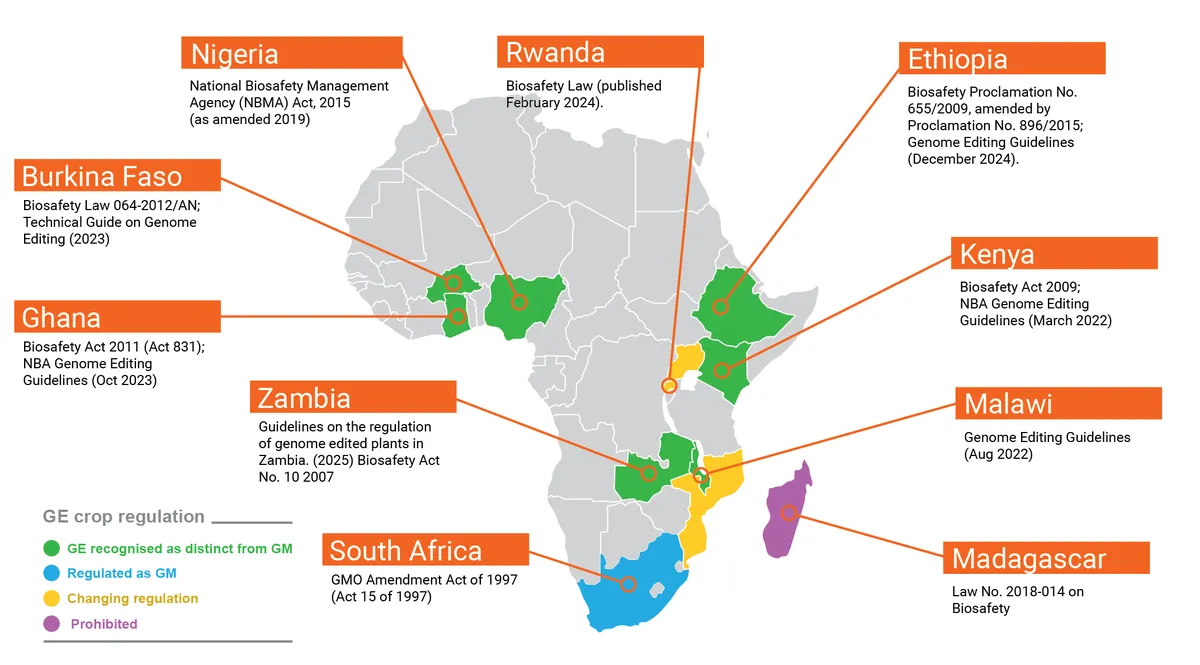
Seven African countries (Kenya, Nigeria, Ghana, Malawi, Burkina Faso, Ethiopia and Zambia) have developed GE-specific regulatory frameworks. Regulatory assessments are conducted case-by-case based on combinations of four criteria: presence of foreign gene elements (from compatible or non-compatible species); presence or absence of markers in the final product; whether a GM phase was used during development; and the type of edit (SDN-1, -2 or -3).
Kenya updated its guidelines in 2025 to incorporate a novelty focus and epigenome edits. Nigeria's framework does not explicitly address SDN type or epigenome edits. Malawi, Burkina Faso and Ethiopia have not set standard decision timelines for GE dossiers. Burkina Faso additionally requires that GE-derived phenotypes exist naturally in other organisms.
Despite permitting commercial GM cultivation, South Africa continues to regulate GEd products under its existing GM framework (GMO Amendment Act of 1997).
Regulatory discussions have also begun in Mozambique, Namibia, Rwanda, Swaziland, Tanzania, Uganda and Egypt. The new CAADP strategy (2026–2035) recognises biotechnology as critical for resilient agri-food systems, and the AfCFTA initiative is expected to drive regulatory harmonisation across the continent.
Asia
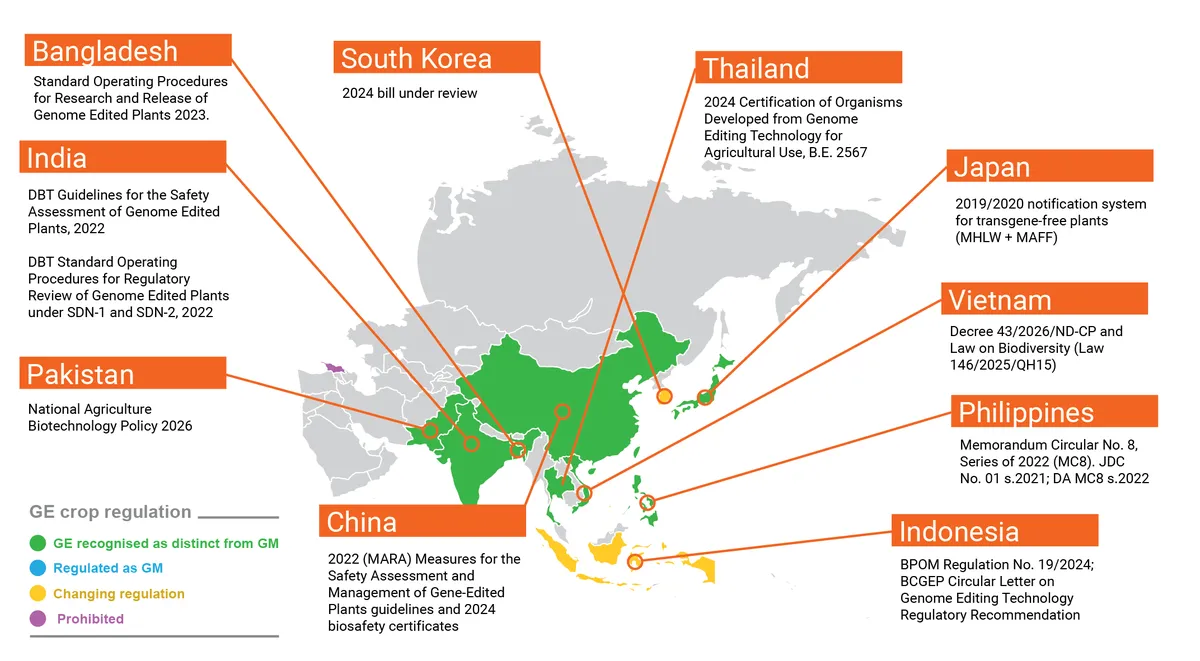
Asia shows considerable regulatory diversity. Japan was among the earliest movers globally, finalising a 2019/2020 notification system allowing transgene-free GEd plants to proceed without full pre-market GMO-style safety review, enabling commercialisation of the high-GABA tomato as one of the first market-released GEd crops.
China's 2022 MARA Guidelines established a streamlined risk-based approval process for plants without exogenous DNA, without full GM exemption; 2024 biosafety certificates extended this to GEd crops, in line with the 2021 Biosecurity Law's goal of expanding GM and GEd cultivation.
India exempted SDN-1 and SDN-2 plants from the 1989 Environmental Protection Act in 2022, establishing case-by-case safety assessment guidelines. The Philippines established GMO-status determination procedures in 2022; Tropic's reduced-browning gene-edited banana became the first product confirmed non-GM under this system and was offered to growers in March 2025. Bangladesh developed SDN-1 and SDN-2 standard operating procedures in 2023, similar to India's approach.
Thailand published regulations certifying transgene-free GEd crops as safe in 2024. Singapore implemented a framework for transgene-free GEd crops for food and animal feed in 2024 with no labelling requirement.
Indonesia released BPOM Regulation No. 19/2024, establishing a case-by-case classification process distinguishing GEd food (requiring full safety approval) from non-GEd food (treated as conventional). Vietnam issued Decree 43/2026/ND-CP distinguishing gene-edited organisms without foreign DNA from GMOs under the amended Law on Biodiversity. South Korea drafted a 2024 bill creating a transgene-free category, though it has not yet been enacted.
Pakistan's Federal Cabinet approved its first National Agriculture Biotechnology Policy in 2026, treating SDN-1 and SDN-2 products as non-GMO, with secondary legislation under discussion.
Australasia
New Zealand initially classified all GEd organisms as GM under the Hazardous Substances and New Organisms (HSNO) Act following a 2014 EPA ruling, narrowed in 2016 to apply only to techniques not in use before 1998. In 2024, the Gene Technology Bill signalled a potential shift toward an outcome-based definition, discussing exemptions for low-risk edits that mimic conventional breeding outcomes.
Australia updated its Gene Technology Regulations in 2019 to exempt SDN-1 organisms from GM classification, though edits involving a repair template remain within the GM framework. In 2025, Food Standards Australia New Zealand (FANZ) updated the definitions of 'novel DNA' and 'novel food' to allow outcome-based evaluation, meaning transgene-free GEd crops no longer classify as GM food.
Emerging future & recommendations
Based on the patterns across global regulation of GE crops, the authors recommend across the following areas to promote the rapid uptake of useful GE innovations:
- Adopt product‑based rather than process‑based regulation: Regulatory oversight should focus on the characteristics of the final product rather than the method used to create it. Given that many GEd outputs are biologically indistinguishable from conventionally bred varieties, applying process-based GMO frameworks to transgene-free products is scientifically disproportionate and creates unnecessary barriers to innovation.
- Align regulation of transgene‑free GEd products with conventional pathways: Where GEd products are genetically indistinguishable from conventionally bred crops, they should follow conventional regulatory pathways. This is both scientifically justified and practically important, as prohibitive GM-equivalent costs force researchers toward slower, less precise methods rather than the best available technology for end users.
- International alignment: Divergent national regulatory frameworks create trade friction, impede research collaboration and restrict seed movement, undermining global food security. Greater international coordination through shared criteria, aligned definitions and mutual acceptance frameworks is essential to enable the full benefits of GEd innovations to be realised across borders.
- Regulatory performance metrics: Regulatory reform alone does not guarantee that GEd products reach market, so there is value in developing performance indicators — covering inputs such as application numbers and time-to-decision, and outcomes such as product approvals and SME participation — to identify which systems are working effectively and share those lessons internationally.
- Communication, transparency and public engagement: Effective public engagement with GEd must go beyond communicating the science, as research shows citizens are principally concerned with governance, accountability and benefit distribution rather than technical details alone. Institutions, researchers and regulators must actively engage across digital media to counter misinformation and shape public understanding, drawing on examples such as ISAAA AfriCenter's media training programme in Kenya.
Reference
Heaton M, Darby C, Ngure GM, Podevin N, Ratemo BM, Slamet-Loedin I & Hundleby P, 2026, Understanding the regulatory status and commercialisation requirements of genome-edited crops, Norwich Institute for Sustainable Development, Norwich, UK, DOI: http://doi.org/10.5281/zenodo.20140399
Map downloads
High-resolution versions of the maps in this article can be downloaded below: