New Zimbabwean guidelines on genome editing regulation
Zimbabwe's statutory biosafety and biotechnology regulator, the National Biotechnology Authority (NBA) has released new guidelines on the national regulation of genome editing. The instrument was approved by the NBA Board on 13 April 2026 through Board Resolution No. 4, acting under section 22 of the NBA Act, and subsequently transmitted to the Ministry of Higher and Tertiary Education, Innovation, Science and Technology Development. The Ministry signified concurrence on 11 June 2026.
Built out of alignment efforts
Zimbabwe is a new adopter of GE regulations within a growing number of African countries, led initially by Nigeria and Kenya. The new Zimbabwean framework was drafted through workshops run jointly by the NBA and AUDA-NEPAD, with the aim of aligning Zimbabwe with regional and international standards to enable competitive biotechnology products for regional and global markets, and Zimbabwe is a participant in AUDA-NEPAD's genome editing pilot project. Accordingly, the new framework aligns within the emerging African model:
- SDN-1/SDN-2 changes where no foreign DNA remains in the final product are considered outside the GMO regime.
- SDN-3 products fit within the existing GMO regime.
The listed techniques included under the gene editing framework are base editing, prime editing, TALENs, ZFNs, ODM and CRISPR. The process is mediated by a mandatory pre-submission consultation with a fixed determination window - following the Argentine Resolution 173/2015 architecture, first used in Africa in Kenya.
One exception to other African countries however is that Zimbabwe retains a 20 nucleotide limit for SDN-2 style changes. This 20-nucleotide threshold is one of the criterion in the EU's NGT Regulation Annex I for Category 1 status (NGT-1). Zimbabwe appears to have brought this EU-derived mutation limit into an otherwise Kenya / Nigeria-style consultative framework.
Process and timing
The guidelines include a decision tree and outline of the application process for applicants with GE products:
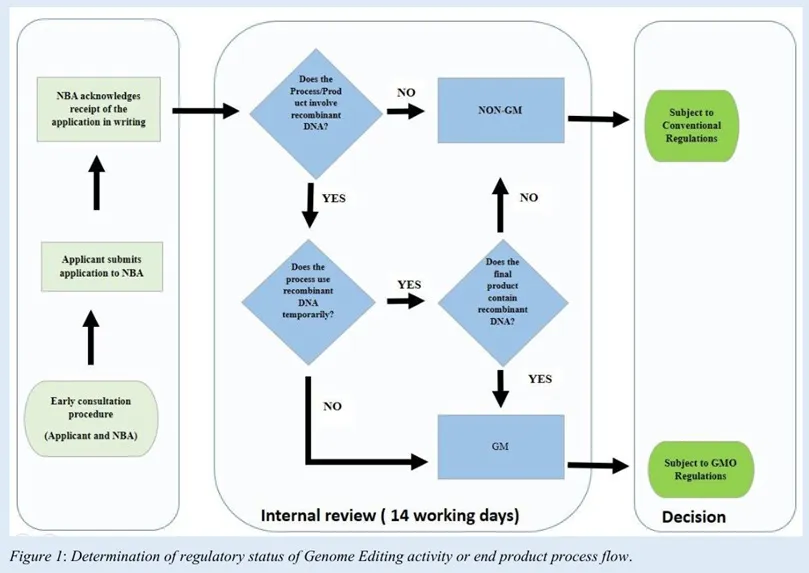
Prospective applicants submit a pre-submission enquiry, not an approval application, from which the NBA determines regulatory status on a case-by-case basis. The NBA must communicate the outcome of this decision within 14 working days, following the "early consultation" model taken by Nigeria and Kenya.
The application annex requires molecular characterisation before and after editing, vector maps and disarmament status and delivery method. Where the transgene has been segregated out, applications must share detection protocols and supporting data evidencing its absence. Where the required data is unavailable, the application defaults to the full NBA Act/GMO regime. There is no self-assessment route.