New report outlines challenges and opportunities to build alignment for genome editing regulation
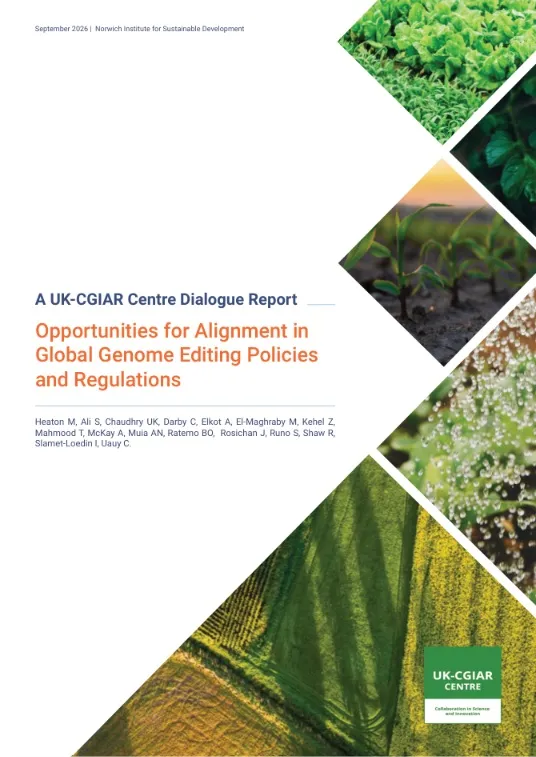
A new Dialogue Report has been published by the UK-CGIAR Centre on opportunities and barriers to alignment in genome editing (GE) regulatory change. The report draws on the insights from six countries and two regional bodies to share challenges and opportunities for how countries could improve alignment in how GE products are categorised, exchanged, produced and traded. Doing so, the report argues, will support streamlined sharing and scale up of potentially useful technologies across jurisdictions.
Context
At the time of writing, there are 34 countries which recognise GE products distinctly from GM, and 39 in the process of changing. As more countries bring in GE regulations, the questions is increasingly not whether a country permits GE crops or not, but how they identify these products and how well the approach aligns with other countries; particularly neighbours and trade partners. Understanding theses differences can feed into policy alignment efforts to maximise societal benefits from GE crops while working across a range of regulatory systems.
The UK-CGIAR Centre conducted a mutual policy learning event in June 2026, bringing together representatives from across eight countries to share the latest GE regulatory developments. Participants were a mixture of policymakers, regulators and plant science researchers with the event providing a space to share challenges and opportunities they saw in ongoing GE regulation and alignment efforts.
Report findings
The event findings and recommendations were published in a UK-CGIAR Centre Dialogue Report, titled "Opportunities for Alignment in Global Genome Editing Policies and Regulations".
The report sets out the global context for gene editing (GE) regulation and offers recommendations to support ongoing efforts towards policy alignment. Such efforts are already under way at the regional level, most notably in Central and South America, where countries have developed coordinated frameworks that make it easier to exchange GE innovations across borders. Drawing on lessons from these initiatives, the report makes five recommendations.
- Establish a cross-disciplinary GE community of practice. Existing GE networks remain fragmented, and more needs to be done to bring together policymakers, researchers, regulators, businesses, communicators, environmentalists and farmers. The report argues that a community of practice could produce the knowledge products needed to build understanding of, and support for, GE as a tool for creating resilient, nutritious and sustainable food systems.
- Improve the monitoring and visibility of GE policies and secondary legislation. Some countries' GE regulations are far easier to find and interpret than others, which creates uncertainty and discourages collaboration with technology developers. Open web tools could make regulatory documents, and the details of the national teams responsible for them, more accessible.
- Strengthen learning and knowledge exchange on public engagement. How best to measure and respond to public perceptions of GE products remains uncertain. Communication strategies need to move beyond the deficit model, recognising that public concerns are rarely rooted in a lack of scientific knowledge alone. Social media should also play a more central role in how GE developments are discussed and shared.
- Explore options for an international instrument or body to guide regulatory alignment and standards. International agreements already shape practice for other genetic resources and technologies, but none has been designed specifically for GE products. Given the pace of regulatory change and the novelty of the technology, international guidelines or a dedicated body could bring clarity, build consensus and provide a foundation for alignment efforts.
- Look beyond genetic modification for lessons in regulatory alignment. Discussions of GE regulation tend to draw heavily on experiences with genetically modified (GM) crops, yet other fields, including biocontrol, gene drives, fair trade and forest certification, offer valuable lessons. These cover risk assessment, risk management, and labelling that signals product qualities otherwise invisible to consumers. Engaging with experts and practices from these areas would give future policy a broader knowledge base.
Taken together, and pursued in partnership with governments and organisations such as the UK-CGIAR Centre, the wider CGIAR system and AUDA-NEPAD, these recommendations could help ensure that GE technologies are governed responsibly while contributing to food security, resilience and sustainable development.
The full report can be found here.
The work took was included with the “Crop genetic improvement for future climate resilience” project, as part of the UK-CGIAR Centre, managed by Centre for Agriculture and Bioscience International. The workshop was led by the John Innes Centre and Norwich Institute for Sustainable Development