Website first week live - What we learned and some updates ahead
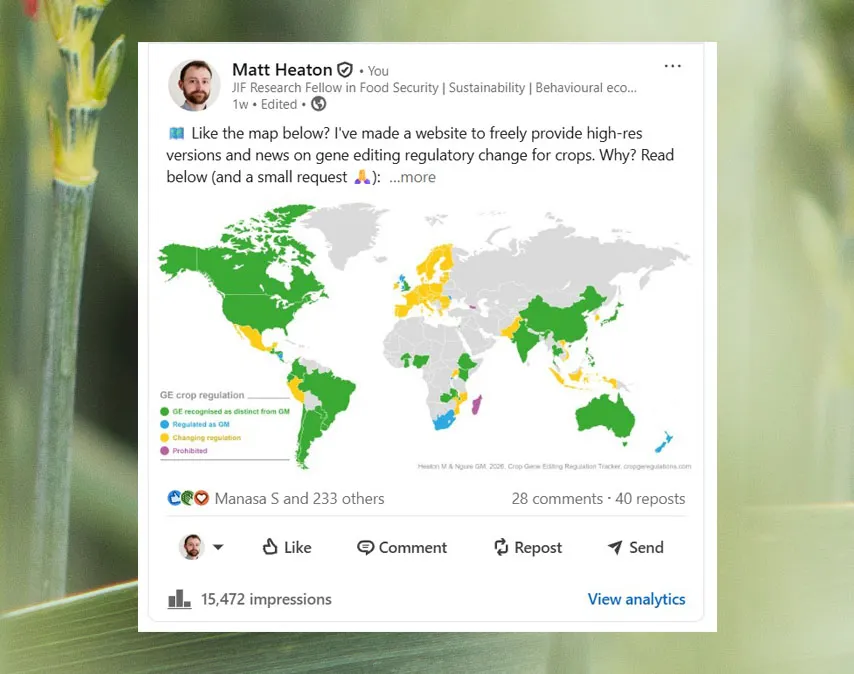
We went live with this site about a week ago and it's been great to see such a positive responses from the community. Thank you to everyone who shared the site, reacted or left a comment. In this post, I'll share some of what we learned from this feedback, what it has changed and how it influences the plans for the site in the future.
"The resource that the gene-editing world has been waiting for."
- Rich Wells, Senior Paten Attorney, Tropic
The first encouraging feedback to see is that this site is both useful and fills a missing gap. I actually find this quite astonishing - that there is so much online content discussing GE regulatory change, and yet nowhere up to date curating this information.
In fact, a repeated comment was, "I wish this was live x months ago when I was doing y study".
To be frank, trawling through government websites for regulatory documents is both difficult and tedious. It seems many of us have been doing this separately, which is a duplication of efforts we can all do without.
Interestingly also, I've discovered some governments have these GE regulations on pages that are not discoverable online, or cannot be shared outside the country. Others are only provided by emails from regulatory staff. I have some plans of how the site can overcome and prevent these reduplication and visibility issues in the future.
Another hunch the feedback confirmed is that sharing this work openly and transparently as a community effort would encourage others to reach out to amend / refine our work.
The eagle-eyed amongst you will notice that the current site map has been updated from that in the LinkedIn post, which thanks to the community reaching out to us to help us in our mission. We hoped this would happen, but I've been inspired by how generously collaborative some individuals have been with their time to support us - thank you to those in this group! Going forward, this site will do more to recognise such individuals.
Lastly, before I get into the planned updates, it has been nice to hear support for the design concept for the site. We've gone deliberately simple and lightweight, and this has been well received as easy to browse and quickly find the information. We will be adding more to the site, but I will do so while maintaining this design philosophy.
Related to this last point, I'm keen to avoid reinventing the wheel in reproducing existing content elsewhere online.Instead this site will point to such resources - please let us know if there are some you think we should point to.
A last quick point to confirm from feedback, this website is for GE crop regulations (hence the URL). We do not currently have capacity to add livestock and medical GE regulations, although I am open to individuals who might wish to help here in the future. At present though, we have no plans to extend the site beyond a crop regulation focus.
Planned updates
Thanks to some great feedback, we have some updates in mind for the site in the future.
Clarifications
The first is that we will add more clarification on how the maps are made. A point that repeatedly came up was why x country is down as 'changing regulations' or 'draft conventional' when the reporting individual knows a new law has been accepted. We know this is the case in some countries, especially where a law has passed but secondary legislation has not been brought in.
To clarify our process: this site will only confirm new changes as complete / enacted when we have an online source or document we can (and will) link to. Doing so means we might be slightly behind, but users can be confident that regulations we mention have citable evidence to support it, rather than word of mouth.
The second is that we need to add clarification on our precision breeding map. What counts as precision bred or transgene-free varies with context - recognising also that the 'precision bred' term isn't used uniformly.
Some states are straightforward in deeming precision bred status on a product that does not contain recombinant DNA from outside the breeders' pool.1 Others however focus on the process (SDN-1) or details such as the number of mutations or length of base pair changes (e.g.20 mutations and 20 bp change limit in the proposed EU NGT1 framework). Cisgenics is also a source of contention. We will clarify on what we are trying to show on our precision breeding map and the variety within this.
Direct links for acts, frameworks, regulations & normatives
In the future, our country table pages will have more direct links to regulatory documents, by jurisdiction, to quickly help users find the relevant documents. Such links will be provided with brief accessible text explanations, and links to regulations in multiple languages (where possible).
As part of the above, we will produce an openly accessible Google Sheets document so users can quickly access all of this information in one place.
Creating this additional content for each country will gradually be added to the site, and will be informed by ongoing contact with regional experts (more on that below). This content may exist in either regional or country pages - we'll trial different approaches of whatever feels best to curate this information.
Managing this additional content is no small task. Regulations are updated and links change or break. Adding links to the site makes for a more substantial resource, but it brings with it greater monitoring requirements and the risk of part of the site falling behind if not checked - the very thing we built this site in response to. We are looking into methods to ensure this increase in offering remains current and within our capacity.
Contact pages point to key researchers
People want to help us, and that's been inspiring to find out. One way this can happen is through regional experts.
A general pattern is that individuals working in this space are particularly familiar with one region, but less certain outside of this area. Yet such experts are often asked to write or comment on regulations generally.
We plan to develop a community of practice on our resource page, of individuals to be ambassadors to regional GE regulatory changes. This is not only a huge boon to the community, it helps recognise the incredible efforts of individuals across this space. A win-win.
In the future, both the contact page and the resources page will contain these links, so that the site is not just an information repository but a conduit to community support.
Interactive maps
We had a few requests for interactive maps in the future. My personal view is that the static maps are more use for researchers in presentations and reports, while the interactive maps are more use for individual learning. These two options suit different needs and so while we may add interactive graphs in the future, they would come in addition to the static image and Illustrator files.
On a technical detail, adding interactive maps will need to be done in JavaScript, due to the nature of this website content management system.2 I work in Python and Plotly, so JavaScript will be new to me, but I'm confident it shouldn't be too hard to build and integrate. If however we continue to see increasing demand for interactivity, we may change the site to a different platform which is more suited to these needs.
Next steps
Lots to develop in the future but it's encouraging to see that our small tool is already helping some in this space. Many thanks again for everyone who has helped us so far. Please keep in touch.
- Matt
The pool of genes and alleles available for use in plant breeding, specifically comprising cultivars, landraces, and wild species that can hybridize with the crop.↩
Built on Bear Blogs, which has been a joy to use in pursuit of the original design philosophy of the site.↩